
Saturday, June 2, 2012
Wif 'n Proof Software

Shadow Weave Scarf

I just finished two scarves woven in a Shadow Weave. I have never woven this pattern before and the warping and the weaving was very complex to complete. The draft calls for weaving 76 rows before the pattern repeats, so it took some concentration. That is probably the main reason that it took over a month to get it off the loom. The other reason is that is is woven with two very fine yarns with a sett of 20 epi. The yarns are a vaiegated bamboo and tencel, which gives it a very drapey quality.The pattern comes from Handwoven, January/February 2012. Handwoven's instructions provide an 8 shaft draft and a 4 shaft draft. Using my 4 harness loom, the pattern was not nearly as evident as in the photos in the magazine. Higher contrast between the yarns should help. The scarf is finished with a twisted fringe using the LeClerc fringe twister.

Date Finished May 2012
Loom Newcomb
Weave Structure Shadow Weave
Reed 12 sleyed to 20 epi
Warp Fiber Bambu 7, Rhubarb Patch
8/2 Tencel, Eggplant
8/2 Tencel, Eggplant
Count 8/2
Source Cotton Clouds
Warp Width in Reed 8"
Ends 157
Length 73"
Weft Fiber same as warp
Count 19 ppi
Beat 50/50
Size
Notes Cotton Cloud kit did not have enough of either yarns, and I had to order more.
Friday, June 1, 2012
Cheaper Kitchen Towels

My Mother and Gary's Mother would be proud. I am keeping up both families' thrifty Scottish traditions, as well as following the environmental mantra of Reduce, Re-use, Recycle. I just finished three kitchen towels on the rigid heddle loom in yellow, green and blue. The yarn for these towels came from thrift store cotton sweaters that I have unraveled. Each sweater costs a mere 50 cents and probably generates 8 oz of cotton yarn. If I were to purchase the cotton, it would run $15 for 8 oz. The yarn from these three sweaters could probably make 10 towels. The only other kitchen towels that I have made were during my weaving week at John C Campbell Folk School. If I add up the tuition, the travel and meals for the week, those towels probably cost about $300 each. Next up will be towels in Duke blue with a little Carolina blue accent.
I had some help in "frogging" (highly technical term for unraveling) the sweaters from Gary, Peggy and even Emma. The biggest issue with frogging is the mess that it leaves behind on me, the rugs, the couch. The other benefit, other than cheap yarn, is that it also makes weaving a little more portable. I can always carry around a sweater to unravel even though I can't carry a loom.

Date Finished June 1, 2012
Loom Rigid Heddle
Weave Structure Plain
Reed 12 dent
Warp Fiber Cotton
Count
Color Yellow and Green
Source Thrift Store Sweaters
Warp Width in Reed 18"
Ends 216
Length 2 1/2 yds
Weft Fiber Cotton
Count
Count
Color Yellow, Green and Blue
Mfr
Mfr
Source Thrift Store Sweaters
Beat 50/50
Size on loom 18 x 25, finished 15 1/2 x 22
Notes
Sunday, May 20, 2012
Potholder Looms

I have tried to entice some friends into weaving and haven't had much success to date. So who better to turn into a little weaver, but Emma. I have been waiting for the right time to buy a potholder loom, remember those from girl scouts, summer camp or Sunday School. Yep, they still make the looms and the loops that you weave with. At 5, she is still a little young, but she likes to pick out the colors and she can put the loops on the loom in one direction. She can't quite get the coordination to interlace the second set of loops. But she likes making designs and she loves to give away the finished product - both good starts.

Monday, April 9, 2012
The week at John C Campbell
 |
| Lori and Janet sleying the reed |
One of the things that I did not know till I got to class was Susan's family history is deep in weaving in Western North Carolina. Lucy Morgan, Susan's Aunt was the founder of the Penland School of Crafts and Susan learned to weave at the age of 9 from her aunt, Lucy Morgan. In class she brought drafting notes and samples from Penland in the 40's, some of which I used during the week.

The week was designed to focus on Scandinavian kitchen textiles, towels, hot mats, table runners in a variety of weaving patterns. I used rosepath, but others in the class used Monk's Belt, Krogsbrad, Halvdral, and twill. Most of us were weaving with 8/2 cotton and the supply of yarn at John C Campbell allowed for lots of variety in the projects contemplated during the week. The other benefit of the week was the library - a wealth of weaving books to spend time pouring over during the session.
Our photos of the week are here:
https://picasaweb.google.com/thomson.pat/JohnCCampbell?authuser=0&authkey=Gv1sRgCJLg0LjC4MCx-QE&feat=directlink
Susan brought in some of her textiles to help inspire us. Most of us made kitchen towels, two or three during the week. I joked that the cost of the two towels I made was about $300 a piece. Some of the class came from Seattle, upstate New York, Illinois and so their towels might have cost about $1000 each.
 |
| My $300 kitchen towel in Carhartt brown |
 |
| Weaving Class Projects |


 |
| Phil Colson - woodturning instructor |
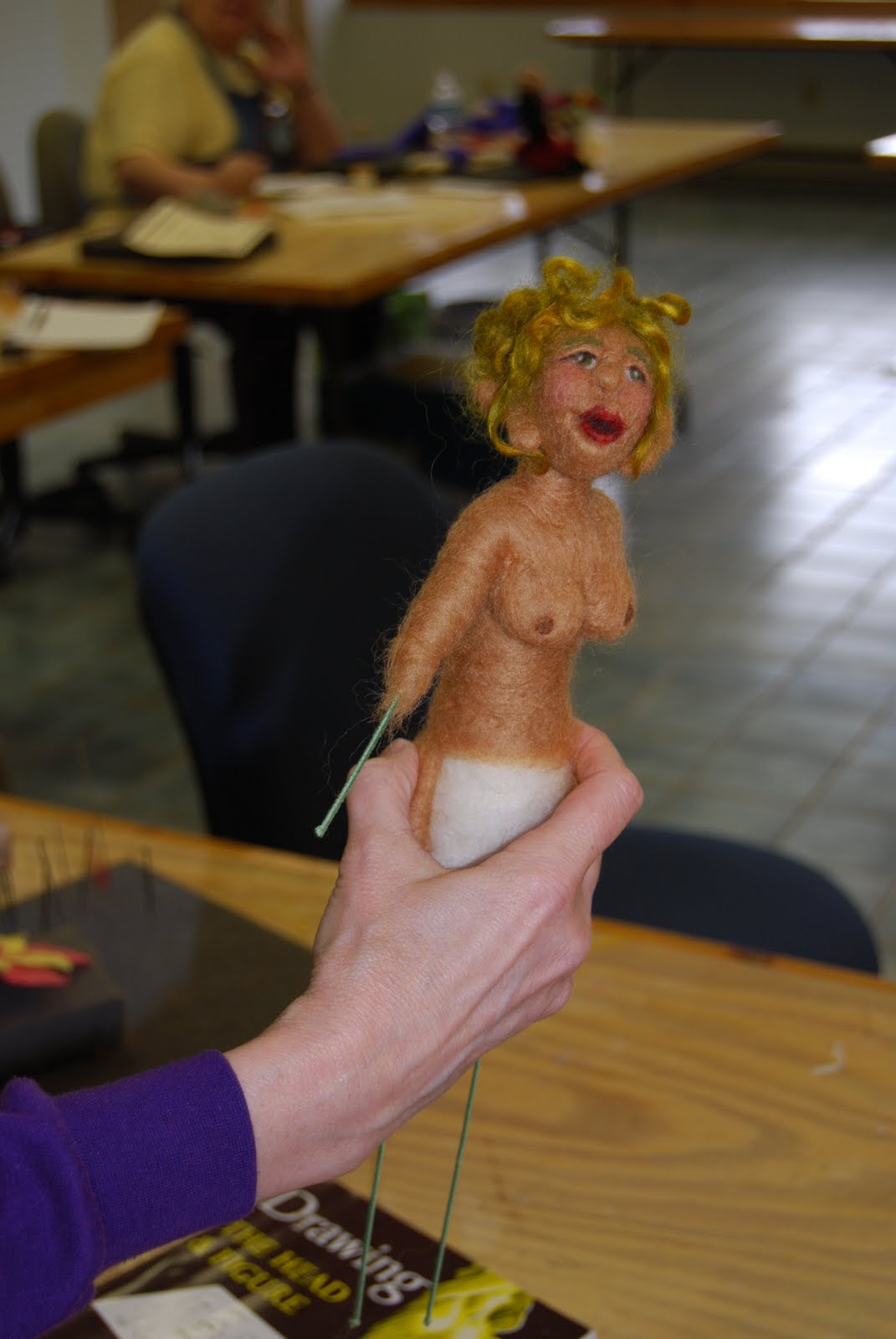
 During the week, there were 15 different sessions going on with a Scandinavian theme, including knitting, ceramics, wood carving, enameling, blacksmithing. My favorite was the needle felting class that made incredible creations by the first day. Friday afternoon, all of the classes got to show off their stuff and it was great fun looking at the production during the week.


Saturday, March 17, 2012
Weaving at John C Campbell Folk School

I am an entirely self taught weaver, picking up techniques by reading books (old school) and by watching youtube videos (new school). I am sure that many of my techniques are not the "proper" or the most efficient way to weave. Because of these deficiencies, I have decided to go to school, John C Campbell Folk School in Brasstown, to study weaving for a week. It may be too late to teach me the right way, but at least I can see what the options are for good weaving techniques.
My primary loom has a sectional warp beam and because of that, I have never warped from front to back. This is a skill I would like to master for a number of reasons. With the Newcomb, I have to climb into the middle of the loom to sley the heddles. It's not a pretty picture and as I get older and wider, this is not the easiest thing to accomplish. In addition, the table loom does not have a sectional warp beam and so it should be warped from the front to the back using lease sticks. I don't even have lease sticks and I wouldn't know where to put them if I had them. I can imagine Gary telling where to stick them....

The course will cover Swedish textiles, so designs typically set at 24 epi. My other interest is Krokgbrad weaving, which is not set as finely, but can produce some interesting detail on warp faced fabric.

Krokbragd almost looks like a Fair Isle pattern for weavers.
Gary is going to JCC as well to study woodturning. Once again he has been turning for a while, but it's entirely self taught. We won't stay on campus, but about 45 minutes away at Lake Burton. Close enough that we can still participate in the evening activities, and yes that means dancing. I just haven't told him yet.
Reversible Rug
 This is another project from Interweave Publications Design Collection 19- all about rags. Rugs seems to be the project that I gravitate to most frequently, utilitarian, sturdy, forgiving of mistakes. This project is woven in a double weave, weaving two layers of fabric at the same time. The fabric on the top layer can be a completely different color from what is being woven on the bottom layer and if you get tired of the colors on the top, just flip it over. It should also result in a very thick rug, since it is made up of two layers.

 The project was sleyed 1-3-2-3 and the 4th harness was not used at all. I think there is probably an easier way to sley this on all 4 harnesses, but I couldn't figure it out, even after reading Black (New Key to Weaving) and Collingwood's rug book. Next time I will probably use cotton carpet warp, since this wool was fairly expensive and is fairly small part of what is seen.
I used the standard tie-up and the following treadling:
From the right
Red tones - 1(lifts 1 and 3)
Black tones - 3 (lifts 3)
From the left
Red tones - 5 (lifts 2 and 3)
Black tones - 2 (lifts 2)
Date Finished March, 2012
Loom Newcomb
Weave Structure double weave
Reed 8 epi, 4 epi per layer
Warp Fiber Navajo wool warp, single ply
Count 190 yds per tube
Color natural
Mfr Davidson
Source Earthguild
Warp Width in Reed 31"
Ends 252
Length 3 yds, used 5 tubes
Weft Fiber wool rags, cut in 1" to 2" strips
Count
Color black, black and white tweeds and plaids on one side and red and black and white tweeds and plaids on the other side
Mfr
Source Thrift Store
Beat Weft Faced
Size
Size
Notes
Subscribe to:
Posts (Atom)