Showing posts with label twice tangled web. Show all posts

Tuesday, August 27, 2013

Plaited Twill Scarf

Another scarf and another new structure, plaited twill.  I love the look of this, but not sure that I like the way it wove up.  There are really two ways to weave the plaited twill.  The first requires that on some of the picks you lift up 7 shafts at a time.  That makes for a heavy lift.  The way that I wove it is physically much easier, only one shaft lifted on some of the picks.  But the downside is that the best side, is woven facing the floor.  You need to either be a contortionist to watch the cloth develop or keep a mirror handy (and still be a contortionist)  The patterning is not apparent on the top side and so of course, I found a couple of treadling errors after I completed the scarf and got it off the loom.  I guess that means another scarf for me.  Drat.

The pattern comes from Handwoven, 8 Shaft Scarves and called for a sett of 20 epi.  I increased this to 25 but I think next time with the tencel warp I will go back to 20 epi.  Plenty of red and gold tencel for another scarf, also have 8/2 in black.


Date Finished
Loom  Baby Wolf
Weave Structure Plaited Twill
Reed 10, 25 epi
Warp     Fiber  tencel
              Count 8/2
              Color  gold
              Mfr
              Source  WEBS
Warp     Width in Reed  6 1/2
              Ends  168
              Length  3 yds
Weft      Fiber tencel
              Count  8/2
              Color red and variegated red
              Mfr
              Source  WEBS
Beat                       50/50                     
Size
Notes

Thursday, April 25, 2013

SOUTHEAST FIBER FORUM


The Southeast Fiber Forum was held at Arrowmont School of Crafts in Gatlinburg in early April.  I attended and took a weekend class in Turned Beiderwand taught by Karen Donde of Sutherland Studios.  Karen is a great instructor, very well organized with lots of information ranging from fairly straightforward to deviously complicated on this old weaving structure.  By turning the Beiderwand structure, it can be woven with one shuttle, which makes the weaving progress much faster.


However, in weaving turned beiderwand, two different yarns are required for the warp and they are taken up differently during the weaving. The pattern warp has much   longer floats and therefore ends up looser on the warp beam.  So it is necessary to either use a second warp beam or do what most of the class did - jerry rig a secondary warp with a piece of wood pretending to be a secondary back beam and weighting the warp to  provide the tension.  This is a technique that can be used any time a supplementary warp is required.  I have read about supplementary warps for other weaving structures, but wasn't sure how to go about this without a second warp beam.


Attached are some of the other student's samples of work created during the week.  We sampled a wide variety of turned structures, including Turned Beiderwand at 1:4, 1:3, and 1:2. I was using 8/2 cotton for the ground warp and weft and a 5/2 cotton for the weft.  Most of the rest of the class was using a 10/2 yarn for the ground warp and weft.  This meant that my sample had very long warp floats, especially on the 1:4.


The other weave structures that we turned were:

  • Summer and Winter
  • Extended Summer and Winter
  • Even Tied Overshot
  • Uneven Tied Overshot
  • Paired Tie Weave
  • Half Dukagang


  The photo to the left is of our class assistant Dana's work.  Dana brought a borrowed Baby Wolf 8- shaft loom to class, just like my loom.  The person she borrowed it from, offered it up for sale and I bought it immediately.  I have been looking for a loom to take to Montana, so I don't have to drive one out and back on every trip. Dana used a pink supplementary warp on a green weft and not only did I get the loom, but she also left her remaining warp on the loom, which I have been weaving off with a burgundy tencel as weft using a Turned Extended Summer and Winter draft.


 It is hard to put an additional warp beam on a Baby Wolf because the back beam is not square - it comes out from the loom at an angle.  This makes it difficult to attach another back beam using clamps.  Once I got back to Brevard, Gary made a creative solution for the Baby Wolf by building a frame with a secondary back beam that slips over the original back beam leaving a space of about an inch between the two warps.  The supplementary warp can be run over this beam and weighted using water bottles and S-hooks.

Saturday, March 9, 2013

Snap, Crackle, Pop


I just tackled another new-to-me weave structure, crackle.  Crackle is also known as Jamtlandvaev in Swedish weaving terminology.  The American name for the weave structure comes from the pottery terminology for a type of glaze.  Some of the colors in the woven cloth just barely peak through, like the crackles on a ceramic pot. And crackle is a whole lot easy to spell and pronounce than Jamtlandvaev.

These towels were woven with a 4 block crackle using 4 colors.  In each single color warp block, there are at least 3 options for color - the warp color, the tabby weft and the pattern weft.  Crackle is similar to overshot because you weave a tabby shot and then a pattern shot.  This gives a huge variety of color options once the loom is warped.  I used 4 colors for the warp: tan, pumpkin and burgundy in 8/2 cotton and a navy blue yarn frogged from a cotton sweater.  The pattern weft floats over up to three warp ends at a time.

Researching crackle, the set up sounded complex, but it's actually easier to weave than it is to read the instructions.  It's a block weave, with the rule that at the end of each group of the same blocks, you need to add another warp thread called an "incidental".


A  is threaded: 1, 2, 3, 2
B is threaded:  2, 3, 4, 3
C is threaded: 1, 4, 3, 4
D is threaded: 1, 4, 1, 2


A = 1
B = 2
C = 3
D = 4


In one of the towels, I used the same tabby throughout.  The other three, I just selected colors randomly.  On some, I was consistent in the number of picks per block - 16 tabby and 16 pattern.  On the other towels, I mixed it up, which resulted in thick and thin rectangles in a wide variety of color combinations.  The other benefit is the front and back sides of the cloth can end up with different color variations.

The starting point for these towels came from Country Rustic Towels, Best of Handwoven, A Dozen Projects Using 8/2 Cotton.

Date Finished  March 2013
Loom  Baby Wolf
Weave Structure  Crackle
Reed  12, 16 epi
Warp     Fiber  cotton
              Count  mostly 8/2
              Color tan, burgundy, pumpkin, navy
              Mfr  Dragon Tail
              Source  Earth Guild
Warp     Width in Reed  22 in
              Ends  354
              Length  4 yds
Weft      Same
Beat        More   Weft Faced        
Size  Finished 19 x 24
Notes  - These towels are wider than a typical dish towel.  Next time, I'll narrow the warp.  Ended up with 3 towels and a small handtowel.


Wednesday, February 13, 2013

Weaving Tools - Handmade


Weaving takes an incredible amount of stuff to get to the point that you can put a warp on a loom and weave it off.  Warping board, cone holder, heddle hook, reed hook, temple, bobbins, bobbin winder, fringe twister, boat shuttle, ski shuttle, stick shuttle,,,,, The list goes on and on and on.  Then there is the yarn, different colors, different sizes, different fibers.  All of this is to say is that it takes serious coin to be a weaver.  It is very different than knitting a sweater where you need knitting needles, yarn and a pattern and you are ready to go.  I was lucky enough to have started weaving over 40 years ago and accumulated a fair number of weaving tools at that time, when costs were pretty low.  My 45" 4 harness loom cost $350 new in 1972, today that loom would run over $2,000.  But instead of going broke buying tools, I have a DH who is a superb wood worker and he has made me quite a variety of tools, some patterned after the standards and some of his own invention.

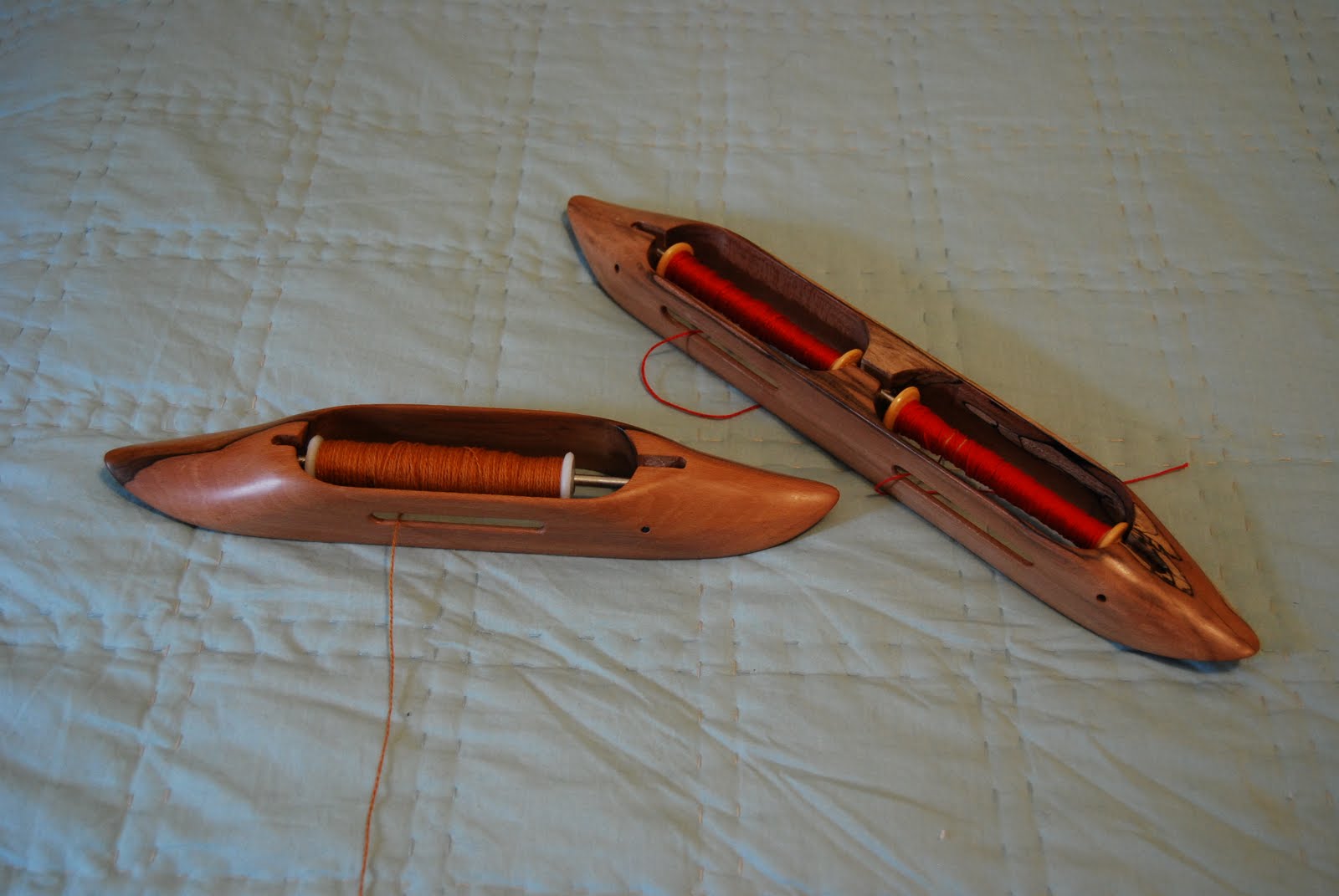
For Christmas this year, he made the beautiful boat shuttle to the left.  It has an open bottom and holds the Schacht size bobbins and feeds easily through the shed.  It came from a dead dogwood tree that DH  cut down at a house he was remodeling in Brevard.  Since I weave in two locations that are 2000 miles apart, I can never have enough boat shuttles.  I am currently weaving crackle towels that have 4 color changes and so I am using every one of my 4 boat shuttles in Montana.


Late last year, I was working on a project that required a double yarn for the pattern weft and winding two threads on a bobbin does not always lead to both yarns pulling evenly out of the shuttle.  The double boat shuttle solves this problem by winding two separate bobbins.  This shuttle is also made of dogwood, which has been used for making weaving tools for ages because of it's hardness and close grain.


Wolf Trap Snuggy

 This ingenious little piece of wood snugs up my Wolf Trap on the Schacht Baby Wolf Loom.  Without it the Wolf Trap was always falling off the front beam.


Reed Holder

The reed holder arrived unanounced in my studio, I think because I was always borrowing DH's clamps whenever I wanted to sley the reed.  As a front to back warper, I usually sley the reed on a table, instead of on the loom.  I have used clamps, soup cans or whatever was on hand to hold the reed in an upright position.


Cross Holder

Another tool for warping, just a small block of wood with 4 nails to hold the cross.  I can walk away from warping and not loose the cross.  This little invention came from Barbara Miller of the Western North Carolina Fiber/Handweavers Guild.


Nostepinne

Scandinavian tool for winding balls.  I have used this for unwinding sweaters purchased from thrift stores.


Inkle Loom

Gary made this inkle loom in a day, when I thought I would be taking an inkle weaving class.  Unfortunately the class was full, but fortunately I got a great little loom for making bands.