Showing posts with label wncfhg. Show all posts

Monday, October 12, 2015

Napkin Exchange Final Results

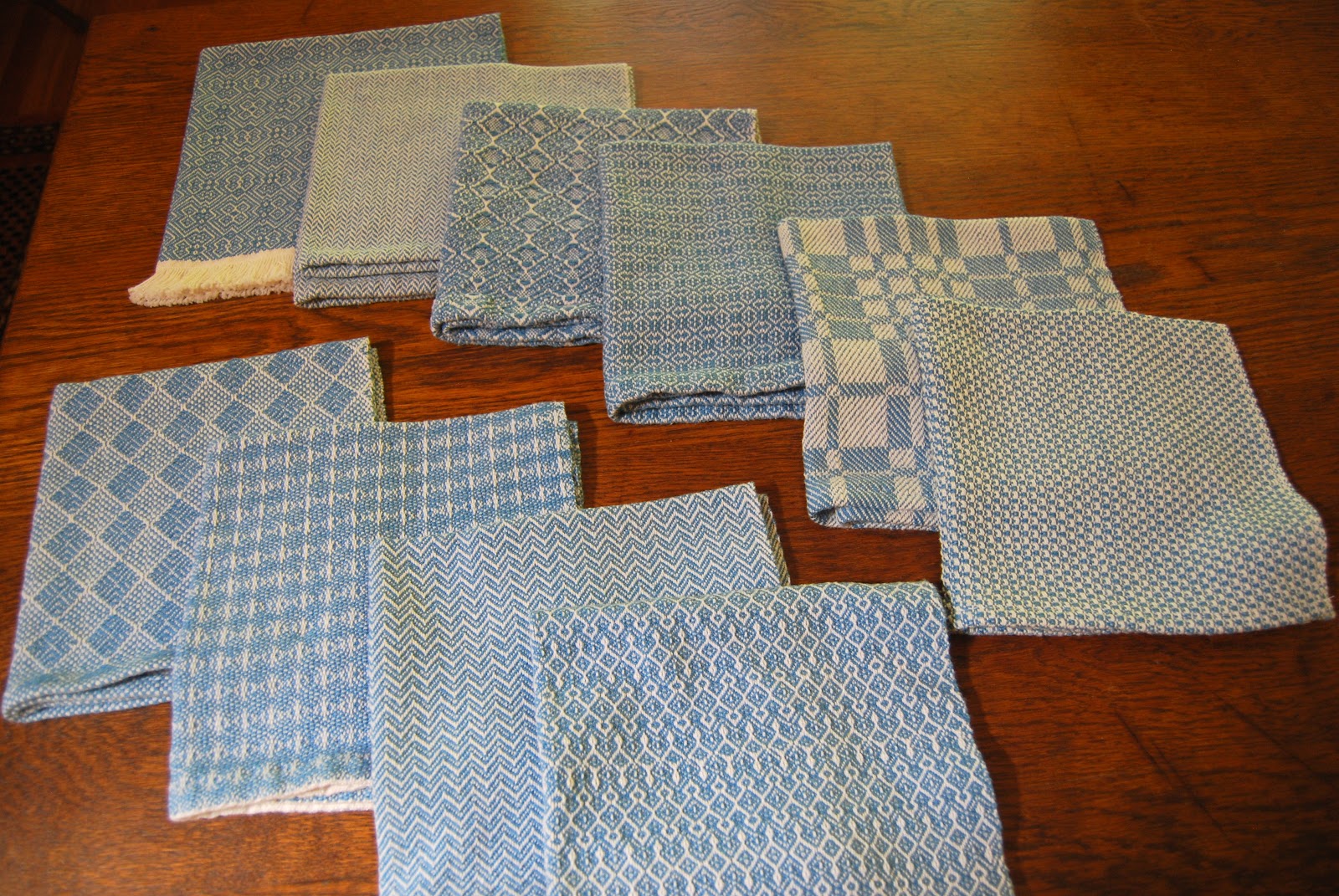
The napkin exchange project was finished over a year ago, but I never got around to posting photos of the 7 napkins I received from my fellow weavers.  This was a fun project and I need to participate in other exchanges, whether its more napkins, towels, or other handwoven items.  I enjoyed thinking, planning and weaving up the napkins, knowing that they will be used by seven other weavers.  We had plenty of time to complete the exchange so there were no deadlines to worry about.  My only issue was that I would not be in town the day of the exchange, so I had to deliver my napkins in advance and not get to see the other three groups.  I wove three additional napkins in my color and added to the 7 from the exchange, I now have 10 napkins and 10 matching placemats.  The three napkins I wove are the three on the right hand side of the bottom row.

Date Finished  October 2014
Loom  Baby Wolf
Weave Structure  Fancy Twill
Reed  10, 20 epi
Warp     Fiber  Cotton
              Count  8/2
              Color  Natural              
Warp     Width in Reed  20"
              Ends  402
              Length  7 yds
Weft      Fiber  Cotton
              Count  8/2
              Color  Various
              Mfr  Valley
              Source  WEBS
Beat                       50/50                     
Size  Made 10 napkins
Notes


Sunday, October 19, 2014

BOUNDWEAVE with Tom Knisely

 I recently completed a 3 day workshop with Tom Knisely on Boundweave.  It was a great workshop, primarily because Tom is such an entertaining teacher and also because I will definitely weave a rug or two using the techniques learned during the workshop.


For the class, we each brought our own loom to the Folk Art Center, warped with doubled carpet warp at 6 working epi in a rosepath threading.  We used either rug wool or mop cotton yarns for the weft in a variety of treadling sequences.  I ended up with a sample piece that is about 70 inches long and thick and sturdy enough for a rug using rug wool as weft.  The weft yarns were mill ends from R & M Yarns in Tennessee and some beautiful wool yarns picked up during my recent trip to New Mexico at Tapetes de Lana.

Exercise 1, shown in the top photo in cream and camel, is a two color treadling woven on opposites.

Exercise 2, 3 color with the treadling reversed to create "eyeballs".
Exercise 3, with 4 colors, resulting in a flame stctch look.  


Exercise 4 with 3 colors
Exercise 5 with 4 colors and the treadling reversed to create diamonds
Exercise 6, 2 colors

Placemats to Match


My weaving guild, the Western North Carolina Fiber/Handweavers Guild, had a napkin exchange this summer.  The finished napkins will be exchanged at our Guild meeting in November.  Since I am weaving napkins, I decided to weave matching placemats using the same color, Mediterranean Blue.  The placemats are woven using a huck boxes pattern.  For some reason the placement of the boxes is not centered on the placemat.  Next time, I will change the threading to provide more symmetry in the design.

The placemats are woven with a thick 3/2 cotton set at 12 epi, so they weave up very fast.  I ended up with 10 placemats and I will have 10 napkins (7 from the guild exchange and 3 extras that I finished).  I have woven these placemats before in Amber Gold and I plan to weave up some napkins to match. However, I recently tried to re-order the yarn from WEBS, and that color is not available in 8/2 cotton, so I will need to weave with the finer 10/2 cotton.

Wednesday, October 1, 2014

Tom Knisely Boundweave Workshop


My weaving guild, Western North Carolina Fiber/Handweavers Guild (WNCFHG), is having a 3 day workshop next week in Asheville.  The instructor is Tom Knisely, teaching us techniques in Boundweave.  Tom was chosen Weaving Teacher of the Year by the readers of Handwoven magazine a few years ago.  He is the author of several books and videos and is a frequent contributor to Handwoven.  I am excited about the session and looking forward to learning new tools that will help with rug weaving.


I weave primarily with cottons, and plant based synthetics like tencel and bamboo, but we will be using a heavy weight wool yarn (800-1000 yds/lb.) for the weft for the workshop.  I didn't have any wool yarn so that required adding more yarn to my stash.  I ordered some from R & M Yarns in Tennessee, mostly in neutrals and browns.  To liven things up a bit, I found a few more colors in New Mexico last week along the New Mexico Fiber Trail.

Wednesday, May 14, 2014

Crackle Weave Workshop


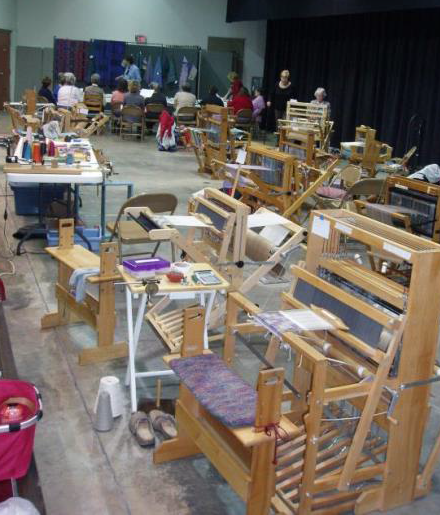
Teena Tuenge of Western North Carolina Fiber/Handweavers Guild recently taught a weekend workshop on crackle weave.  The workshop was a fundraiser for the Blue Ridge Fiber Show which will be held in the fall of 2014 at the WNC Arboretum.  The workshop was attended by about 20 participants in the auditorium of the Folk Art Center. This was a workshop where we all warped our looms in advance and then spent two days playing with weave structure, treadling, and color sampling.  Teena provided us with treadling and tie up instructions for about 20 different weave structures, all using the same crackle threading.


By the end of Sunday, I had woven over twenty different samples using the crackle threading, mostly crackle tie-up but a wide variety of treadlings.  Granted most of the samples were only a few inches long, but enough to tell how the different treadling affects the final cloth.  The crackle notebook that I created with the samples and treadling instructions, finally inspired me to wet finish the samples and finish the notebook for a class I took a year ago at Arrowmont on Turned Beiderwand.


After weaving the samples, I wove off the balance of the warp in the classic crackle treadling and created a lovely piece of cloth, 8" by 30 inches.  Once again, I am not sure what the future life of the is will be - a tablet cover, a small purse, or will it stay in place as an unfinished table runner.

Date Finished  March, 2014
Loom        Baby Wolf
Weave Structure  Crackle threading, many                                           treadlings
Reed  12, 24 epi
Warp     Fiber   Cotton
              Count    10/2
              Color    Pistachio, Avocado, Quarry and                              Yellow
              Mfr  Uki
              Source  Georgia Yarn Co and Yarn Barn
Warp     Width in Reed  9 in
              Ends 222
              Length  4 yards
Weft      Fiber  same
              
Beat       Weft Faced    

Wednesday, February 13, 2013

Weaving Tools - Handmade


Weaving takes an incredible amount of stuff to get to the point that you can put a warp on a loom and weave it off.  Warping board, cone holder, heddle hook, reed hook, temple, bobbins, bobbin winder, fringe twister, boat shuttle, ski shuttle, stick shuttle,,,,, The list goes on and on and on.  Then there is the yarn, different colors, different sizes, different fibers.  All of this is to say is that it takes serious coin to be a weaver.  It is very different than knitting a sweater where you need knitting needles, yarn and a pattern and you are ready to go.  I was lucky enough to have started weaving over 40 years ago and accumulated a fair number of weaving tools at that time, when costs were pretty low.  My 45" 4 harness loom cost $350 new in 1972, today that loom would run over $2,000.  But instead of going broke buying tools, I have a DH who is a superb wood worker and he has made me quite a variety of tools, some patterned after the standards and some of his own invention.

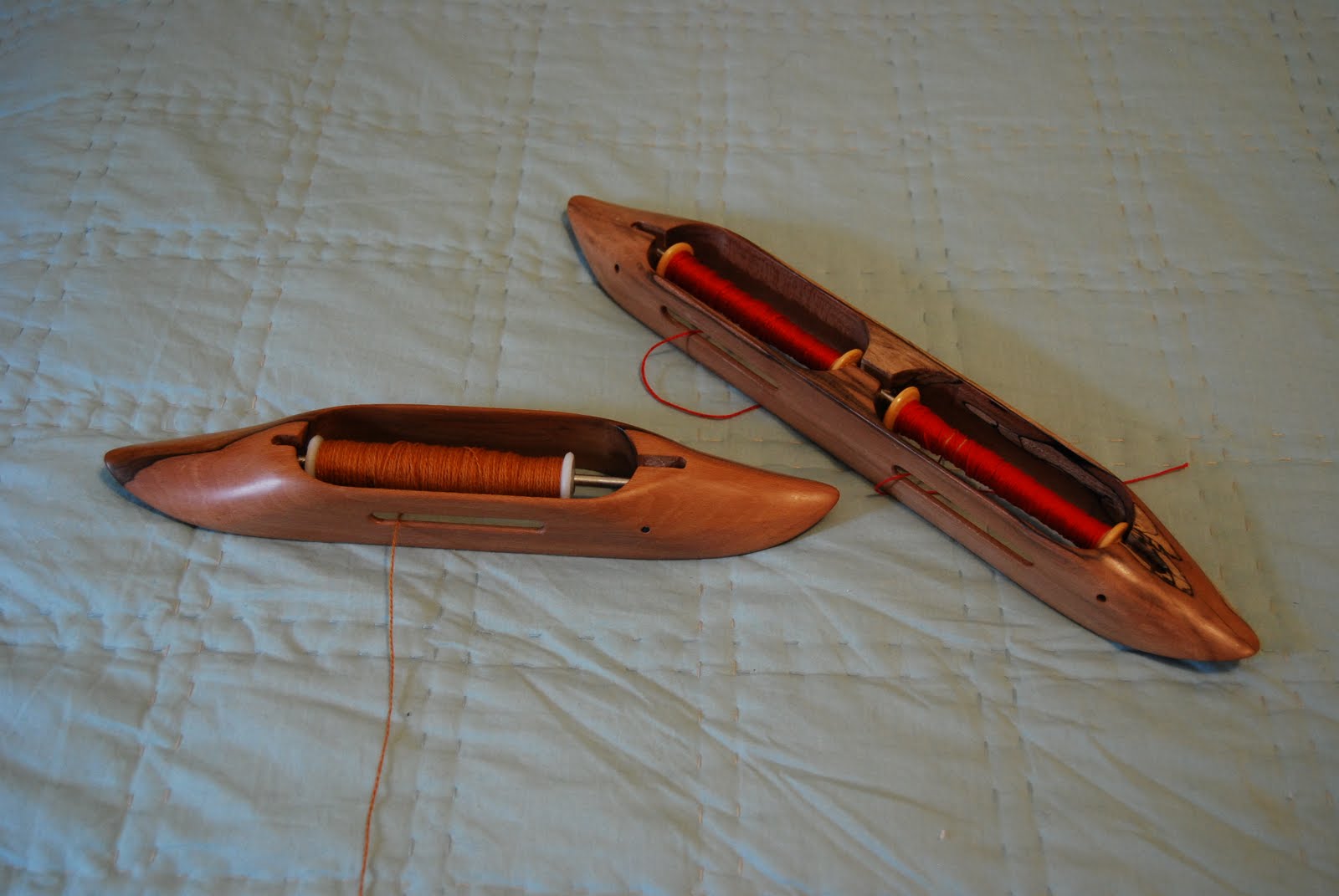
For Christmas this year, he made the beautiful boat shuttle to the left.  It has an open bottom and holds the Schacht size bobbins and feeds easily through the shed.  It came from a dead dogwood tree that DH  cut down at a house he was remodeling in Brevard.  Since I weave in two locations that are 2000 miles apart, I can never have enough boat shuttles.  I am currently weaving crackle towels that have 4 color changes and so I am using every one of my 4 boat shuttles in Montana.


Late last year, I was working on a project that required a double yarn for the pattern weft and winding two threads on a bobbin does not always lead to both yarns pulling evenly out of the shuttle.  The double boat shuttle solves this problem by winding two separate bobbins.  This shuttle is also made of dogwood, which has been used for making weaving tools for ages because of it's hardness and close grain.


Wolf Trap Snuggy

 This ingenious little piece of wood snugs up my Wolf Trap on the Schacht Baby Wolf Loom.  Without it the Wolf Trap was always falling off the front beam.


Reed Holder

The reed holder arrived unanounced in my studio, I think because I was always borrowing DH's clamps whenever I wanted to sley the reed.  As a front to back warper, I usually sley the reed on a table, instead of on the loom.  I have used clamps, soup cans or whatever was on hand to hold the reed in an upright position.


Cross Holder

Another tool for warping, just a small block of wood with 4 nails to hold the cross.  I can walk away from warping and not loose the cross.  This little invention came from Barbara Miller of the Western North Carolina Fiber/Handweavers Guild.


Nostepinne

Scandinavian tool for winding balls.  I have used this for unwinding sweaters purchased from thrift stores.


Inkle Loom

Gary made this inkle loom in a day, when I thought I would be taking an inkle weaving class.  Unfortunately the class was full, but fortunately I got a great little loom for making bands.
Monday, December 24, 2012

Blue Ridge Fiber Show


The Blue Ridge Fiber Show is a biennial exhibition sponsored by the Western North Carolina Fibers/Handweavers Guild.  As a new member of the Guild, I had never been to the show before.  It was hung in September and this is the last week it will be displayed, so I just barely made it before it is dismantled.  Some beautiful examples of weaving, felting, and spinning are displayed with entries submitted from around the country, not just Guild members.  This was a juried show and all of the winners of the BRFS can be seen here. 

The Guild also took an old two harness barn loom and Guild members demonstrated weaving during the run of the show. 


The show is held at the NC Arboretum, located just south of Asheville.  December is not a great time to visit the Arboretum, since most of the plants are dormant.  But you can see the structure of the gardens and I can't wait to go back in the Spring.